
William’s Corner: Insights From Our Participants
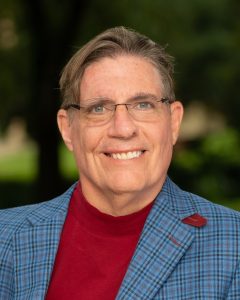 I am a Senior Lecturer at Florida State University (FSU) specializing in accessibility standards, workforce accommodations, leadership, and applied learning. As a two-time quadriplegic, I firmly believe in the disability advocacy adage: “Nothing about us without us.” With this perspective in mind, I encourage my fellow readers and Spinal Cord Injury (SCI) survivors to engage with the Human Engineering Research Laboratories (HERL).
I first learned about HERL’s innovative work while serving as a Presidential appointee to the U.S. Access Board (2002 – 11). HERL was one of the presenters on our standard-setting work. At the time, we were focusing on transportation, outdoor accessibility, and public rights-of-way.
Years later, Dr. Rory Cooper, the Director of HERL, visited FSU as a guest lecturer in our College of Medicine. During his lecture, he emphasized the power of adaptive technology, the importance of lived experiences, and the need for cross-disciplinary collaboration to promote independence and self-sufficiency in the SCI community. Over dinner, I shared my modest attempts at mini golf and a friendly competition with friends. After hearing about my duct-taped apparatus, he mentioned that HERL might be able to help!
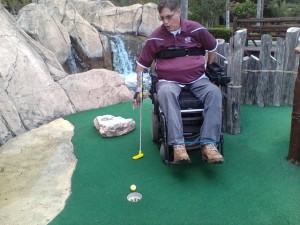
Before the night ended, he introduced me via email to Dr. Jon Duvall, a fellow quadriplegic and a member of his research team. Over the next few months, Jon and I collaborated to transform my makeshift duct-taped solution into a more durable, less painful design. His 3D-printed adaptive technology (AT) not only secured the putter for me but also improved the stability of my golfing motion. This partnership significantly improved my game, allowing me to compete effectively against my wife, friends, and personal care assistants.
As a former varsity athlete who enjoys winning, I knew intuitively that we could further upgrade the equipment. My journey to elevate my game continues with four FSU undergraduate bioengineering students: Kassandra Abreu, Jordan Brown, Kennedie Cearlock, and Kayla Kirchknopf. These students evaluated Dr. Duvall’s design, studied my body mechanics, and focused on making the solution simple, functional, and intuitive.
Through my collaborations with Dr. Duvall, I was introduced to Dr. Brandon Daveler, another member of the HERL team and a fellow quadriplegic. He has significantly contributed to numerous HERL innovations, including a waterproof pneumatic power wheelchair. Currently, he is designing a collapsible wheelchair that can fit into a van without a ramp. The challenges with Accessible and affordable transportation presents major barriers to employment, healthcare, and overall independence for the SCI community. Avoiding reliance on an expensively modified vehicle could be transformative.
For me, this research is deeply personal. It transforms recreation from a frustrating hobby into something I can fully enjoy. Competitive adaptive mini-golf is more than play; it symbolizes progress from improvisation to innovation and from exclusion to belonging. I hope to achieve a hole-in-one on demand during their capstone presentation in April. The pressure is on, but it’s all good fun. With practice, I aspire to break par one day!
With my experience in national and state rulemaking in the transportation sector, I was invited to serve as one of the peer mentors on this project. I find it incredibly satisfying and intellectually stimulating to solve problems, particularly those that affect us personally, which is at the heart of advocacy.
One challenge in scientific research and public policy is obtaining a sufficient sample size for analysis. The issue is not that we do not exist; rather, it is about how to get involved, whom to contact, and how to make a genuine commitment to follow through. We cannot address our shared problems if we do not take part in the solutions. We need to support each other to ensure that decisions are made with us, not without us.